The diving cylinder, explained
What a scuba cylinder stores, how it’s built, why pressure matters, and how to read the stamps on its shoulder. Start here if you’re new — or brush up before you buy.
A diving cylinder stores compressed breathing gas — air, nitrox or trimix — at 200 to 300 bar, and releases it on demand through the regulator. That’s the whole job: hold a lot of gas safely, and hand it over at a breathable pressure when you inhale.
Three parts do the work
The cylinder body
A seamless pressure vessel in chromium-molybdenum steel (EN 1964) or 6061 aluminium. The shoulder carries the stamps; the base often takes a rubber boot so it stands upright.
The valve
The high-pressure gate between the gas and the regulator. It carries the connection standard (DIN or A-clamp), the on/off spindle, and the burst disc. Sold separately from the cylinder.
The burst disc
A one-way overpressure relief inside the valve. If pressure climbs past the rating, it vents rather than letting the cylinder rupture. Matched to working pressure — never interchangeable.
More pressure, more gas,
same size cylinder
The gas available for a dive is capacity in litres × fill pressure in bar. Raise the pressure and you store more gas in the same physical body — which is exactly why higher-pressure cylinders matter for travel and technical configurations.
| Same 12 L body | Working pressure | Free gas at surface | Equivalent to |
|---|---|---|---|
| 200 bar | 200 bar | 2,400 L | baseline |
| 232 bar | 232 bar | 2,784 L | European standard fill |
| 300 bar | 300 bar | 3,600 L | ≈ an 18 L at 200 bar |
Free-gas figures are approximate (ideal-gas). A 10 L 300 bar stores roughly what a 15 L 200 bar does — the appeal of high pressure where weight and size matter.
Steel or aluminium
Two materials cover almost all diving. Chromium-molybdenum steel (built to EN 1964) carries higher capacity and pressure and stays negatively buoyant throughout the dive — the default for back gas. 6061 aluminium is lighter, corrosion-resistant and non-magnetic, but swings slightly positive as it empties, which suits it to stage and decompression bottles. The buoyancy difference drives most of the decision.
Both materials, side by side

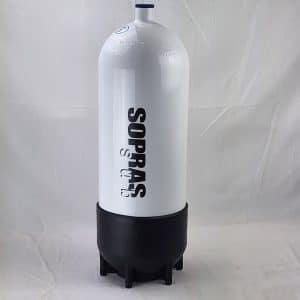
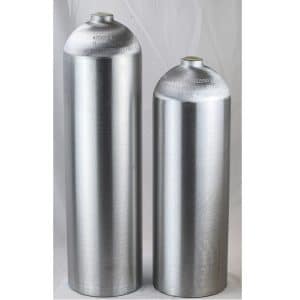
Read the shoulder stamp
Every cylinder is stamped on the shoulder with the information that proves it’s legal to fill. EN 1964 sets what those marks mean for steel. Learn to read them — it’s the first thing to check before buying or filling a used cylinder.
- Working pressure — the maximum fill pressure (e.g. 232 bar)
- Test pressure — the hydraulic test, typically 1.5× working (348 bar for a 232)
- Water capacity — the volume in litres
- Manufacturer & standard — maker’s mark and EN 1964
- Hydro test date — the date of the last hydrostatic test
An expired test date means a commercial station can’t fill it. Steel cylinders are retested on the EN 1964 schedule — typically every five years — with a visual inspection in between.