Valves & threads
The valve is the high-pressure gate between your gas and your regulator. Get the connection, the ports and the thread right — they decide whether your regulator even fits, and whether the cylinder is safe to fill.
A valve screws into the cylinder neck and does three things: it carries the regulator connection standard, it opens and closes the gas with a spindle, and it holds the burst disc that vents if pressure ever climbs too high.
Valve bodies are brass with a chrome-plated finish. The tank thread is M25×2 on European cylinders above 5 litres (small specialty cylinders use M18×1.5). The regulator connection on top is a separate standard — and that’s the one you have to match to your first stage.
DIN vs. A-clamp
The two ways a regulator first stage meets the valve. The difference is how the O-ring is held — and that drives strength and pressure rating.
DIN (EN 144)
- Regulator screws into the valve; O-ring captured inside
- Stronger, rated to 200 / 232 / 300 bar
- Preferred for technical and 300 bar diving
- 200 bar = 5-thread bore · 300 bar = deeper 7-thread bore
A-clamp (INT / yoke)
- Yoke clamps over an external port; O-ring on the port face
- Common on recreational hire gear, generally to 232 bar
- Fits any DIN valve via a DIN-to-A-clamp insert
- The insert suits 200 bar bores — not the deeper 300 bar bore
One port or two?
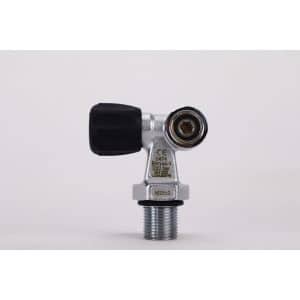 1 PORT
Z valve
A single regulator connection. The standard for recreational single-cylinder diving, sidemount, stage and argon. Turns clockwise to close.
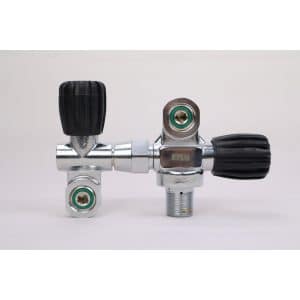 2 PORTS
H & V valves
Two independent connections on one cylinder — run a redundant second regulator, or put a gauge on one port and the regulator on the other.
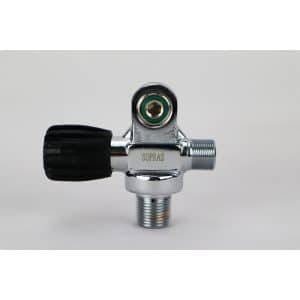 MODULAR
Manifold parts
Left/right monovalves, H-adapters, manifold parts with isolator, second-outlet screws and plugs — to build and service twinset manifolds.
Match the standard to your market
Beyond DIN and A-clamp, valves come in thread and service variants. Confirm yours before ordering — a mismatch simply won’t connect.
| Variant | What it’s for |
|---|---|
| EN 144 (G 5/8″) | The European standard regulator connection |
| 300 bar | Higher-rated burst disc and deeper DIN bore for 300 bar cylinders |
| Nitrox (26×2 / G 5/8″) | Oxygen-clean seals for EAN mixes above 21% |
| US 3/4″ NPSM | North-American regulator first-stage compatibility |
| Conical E17 | Specific legacy regulator configurations |
| M18×1.5 | Small specialty cylinders (e.g. argon, 0.5–1 L) |
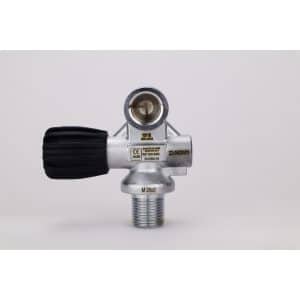
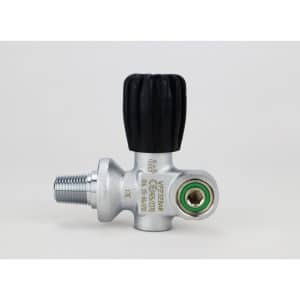
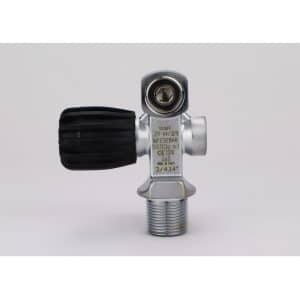
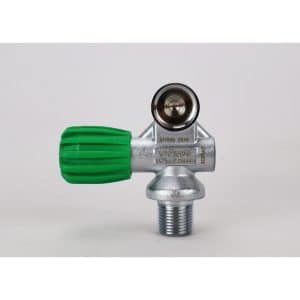
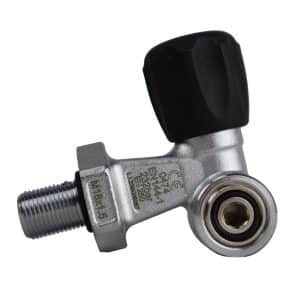
One valve per standard
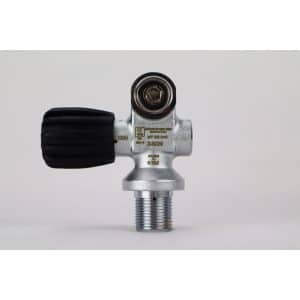
Nitrox & left/right
Nitrox needs an oxygen-clean valve
For EAN above 21%, the cylinder must be oxygen-clean inside and the valve oxygen-rated, with nitrox seals. Standard valves aren’t suitable without cleaning and re-rating. The nitrox variants (26×2 and G 5/8″ nitrox) are prepared for oxygen service.
Left and right valves on a twinset
In a backmount double, the left cylinder takes a left-hand valve and the right takes a right-hand valve. That fixes which way each knob turns — and it’s what makes the standardised valve drill work.
Check the bore O-ring
The DIN bore O-ring is the primary gas seal. Inspect before each use; replace if cracked, deformed or compressed flat.
Hand-tight plus a half turn
Don’t over-tighten the DIN insert — excess torque damages the O-ring and the bore threads.
Silicone only
Lubricate spindle and port O-rings with silicone grease — never petroleum-based lubricant. Fit the dust cap when the regulator is off.