- A manifold joins two cylinders so you breathe from either tank through either regulator.
- The central isolation valve can seal off one side if a regulator, hose or valve fails.
- Without it, a single failure can drain both cylinders at once.
- It’s standard for technical doubles — and must match cylinder diameter and pressure rating.
The problem it solves
Every technical configuration answers one question: if something fails mid-dive, how do you keep breathing and still have enough gas to ascend safely? On a single cylinder, a free-flowing or failed valve can empty your entire supply with no way to stop it. Doubles solve part of that by carrying more gas — but only an isolation manifold lets you protect that gas when a failure happens.
How a manifold works
A manifold is a crossbar that connects two cylinders at their valves. With both side valves open, gas flows freely between the cylinders, so you breathe from either tank through either regulator — effectively one larger, shared supply. In the centre of that crossbar sits the isolation valve.
In normal diving, the isolator stays open and the two cylinders act as one. The moment something goes wrong on one side, it earns its place.
The failure scenario
Say a first stage free-flows, an O-ring blows, or a burst disc lets go on the right post. Gas starts pouring out of that side. You close the isolator, which seals the crossbar and separates the two cylinders. The failed side keeps venting until it’s empty — but the left cylinder is now isolated and intact, holding the gas you need to ascend. You shut down the failed post, switch to the working regulator, and end the dive in control.
Without an isolation manifold — with a plain crossbar, or two cylinders plumbed together without a central valve — that same failure drains both cylinders, because nothing separates them. That’s the whole point of the isolator.
Left and right valves
On a manifolded double, the left cylinder takes a left-hand valve and the right takes a right-hand valve. This fixes which way each knob turns to open and close, which is what makes the standardised valve drill — the shutdown sequence technical divers practise — work consistently under stress.
Do you actually need one?
If you’re a recreational single-cylinder diver, no — a manifold is technical equipment, used with training. If you’re moving into backmount doubles for technical diving, then yes: the isolation manifold isn’t optional, it’s the redundancy principle the whole configuration is built on. It’s covered in technical training before you dive it.
Gear in this article
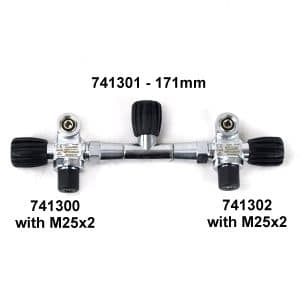 SoprasTekManifold 171-203mm/232bar-ISOL€230
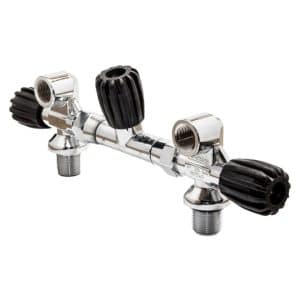 SoprasTekManifold 171-203mm/300bar-ISOL€240
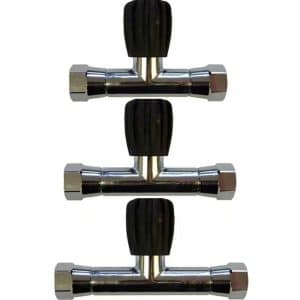 SoprasTekMiddle part with valve isol€103
 SoprasTekClosure for valve isol€16