- Working pressure is the maximum fill pressure — higher pressure stores more gas in the same body.
- 232 bar is the everyday European standard; 300 bar maximises gas where size and weight matter.
- A 300 bar cylinder only delivers its advantage at a 300 bar fill station.
- The valve’s burst disc must match the cylinder — never mix 232 and 300 bar components.
What “working pressure” means
The working pressure stamped on a cylinder’s shoulder is the maximum pressure it’s rated to be filled to. Because the gas you carry is capacity × pressure, raising the pressure stores more gas in the exact same physical cylinder. That’s the whole appeal of higher-pressure ratings.
The three ratings in litres
| Same 12 L body | Working pressure | Free gas | Equivalent to |
|---|---|---|---|
| 200 bar | 200 bar | 2,400 L | the older standard |
| 232 bar | 232 bar | 2,784 L | European default fill |
| 300 bar | 300 bar | 3,600 L | ≈ an 18 L at 200 bar |
The same logic scales: a 10-litre 300-bar cylinder stores roughly what a 15-litre 200-bar one does, in a smaller, lighter body. That’s why 300 bar is popular in technical configurations and for travellers who want maximum gas without maximum bulk.
When higher pressure is worth it
232 bar is the right choice for most divers. It’s the standard fill at virtually every European centre, and the cylinders, valves and regulators are all built around it. Choose 300 bar when size and weight genuinely matter — technical setups optimising buoyancy and cylinder count, or a compact cylinder that punches above its volume. Choose 200 bar only if that’s what your local fill station or existing kit is built around.
The burst disc has to match
Inside every valve is a burst disc — a one-way safety relief that vents if pressure climbs past the rating. It’s calibrated to the cylinder’s working pressure: a 232-bar valve carries a 232-bar disc, a 300-bar valve a 300-bar disc. They are not interchangeable. Fit the wrong one and you’ve created either an under-rated relief that could vent early, or an over-rated one that won’t protect the cylinder. The DIN bore differs too — 300-bar valves use a deeper 7-thread bore versus the 5-thread 200-bar bore.
Gear in this article
 SoprasSubTank 12l diam.171mm 200bar, 232 or 300bar€254 – 350
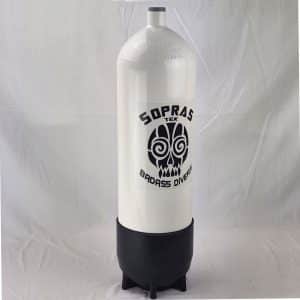 SoprasSubTank 10l 200bar, 232 or 300bar€231 – 292
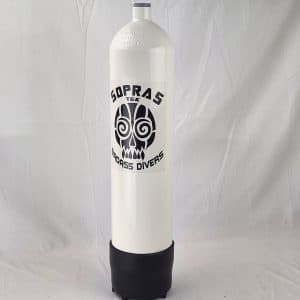 SoprasSubTank 7l 232 or 300bar€215 – 246
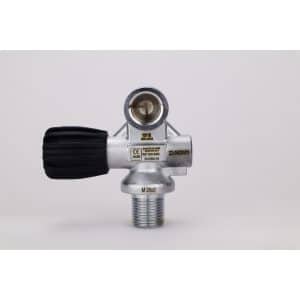 SoprasSubLeft Monovalve 300 bar€79