- Steel stays negatively buoyant for the whole dive — it never flips positive.
- Aluminium starts negative and swings positive as it empties (about +2 kg for an S80 in salt water).
- That swing means aluminium needs a little more lead, planned for the end of the dive.
- Steel suits back gas; aluminium suits stage, deco and travel.
Why buoyancy changes during a dive
Compressed gas has mass. A full 12-litre cylinder holds a couple of kilograms of air, and as you breathe it down, the cylinder gets lighter — which means more buoyant. Every cylinder does this. What separates steel from aluminium is the starting point and the finishing point.
Steel: negative all the way
A steel cylinder is dense and heavy-walled. It’s negatively buoyant when full and becomes less negative as it empties — but it never crosses into positive. The cylinder keeps helping to hold you down throughout the dive, which means you carry less lead on your belt or in your pockets. That stability is exactly why steel is the standard for back gas and backmount diving.
Aluminium: the positive swing
Aluminium has thicker walls to hold the same pressure, but it’s a lighter metal overall, and it displaces more water relative to its weight. It starts negative when full and swings positive as it empties. For a common S80, that shift is roughly +2 kg in salt water from full to near-empty.
This isn’t a flaw — it’s a property you plan around. You add a little more lead to stay down at the end of the dive, when the cylinder is lightest. And because the swing is predictable, aluminium is ideal as a stage or decompression bottle: you know how its buoyancy will change as you use it, and a slightly positive empty bottle is easy to handle and hand off.
Which one for your diving?
For a single recreational cylinder or backmount doubles as back gas, steel wins on capacity, higher pressure and stable negative buoyancy. For stage, deco and bailout — and for warm-water travel where you don’t want to ship heavy steel — aluminium earns its place with its lighter weight, corrosion resistance and that managed positive swing. Many technical divers run both in one configuration: steel on the back, aluminium on the side.
Gear in this article
 SoprasSubTank 12l diam.171mm 200bar, 232 or 300bar€254 – 350
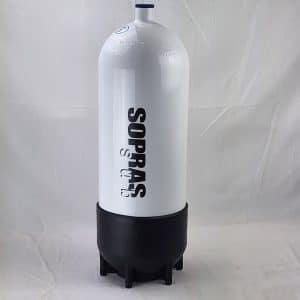 SoprasSubTank 15l diam.203mm 200 or 232 bar€274 – 282
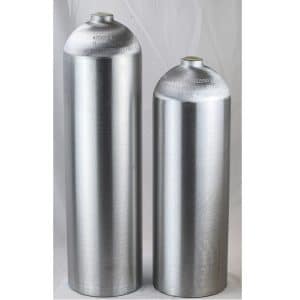 SoprasSubAluminium diving tank CE S80 and S63€227 – 243